
Panther Island Adventures!

Panther Island is 2,800 acres of restored wetland and upland habitats situated in the northwest corner of Corkscrew Swamp Sanctuary's 13,000 acres. It is home to numerous plants and animals including the Florida panther and the iconic wood stork.
The views expressed in user comments do not reflect the views of Audubon. Audubon does not participate in political campaigns, nor do we support or oppose candidates.

Monday, March 26, 2012

Critter of the Week March 26: Mottled Duck (Anas fulvigula)


Florida mottled ducks (Anas fulvigula) are year-round residents of Panther Island. They are non-migratory (one of the few in North America) and are closely related to mallard ducks. Interbreeding between these two species does occur and is a worry for the future of the Florida mottled duck.

These birds nest in Florida from February through July. Nests are usually located in dense vegetation such as grasses, saw palmetto, or rushes) situated near water. Clutch size is typically 8-10 eggs with only 1 brood in a year. Incubation last for 24-27 days. Once hatched, the female will actually move the ducklings to the water within 24-48 hours! And the young can fly at 60 to 70 days old.
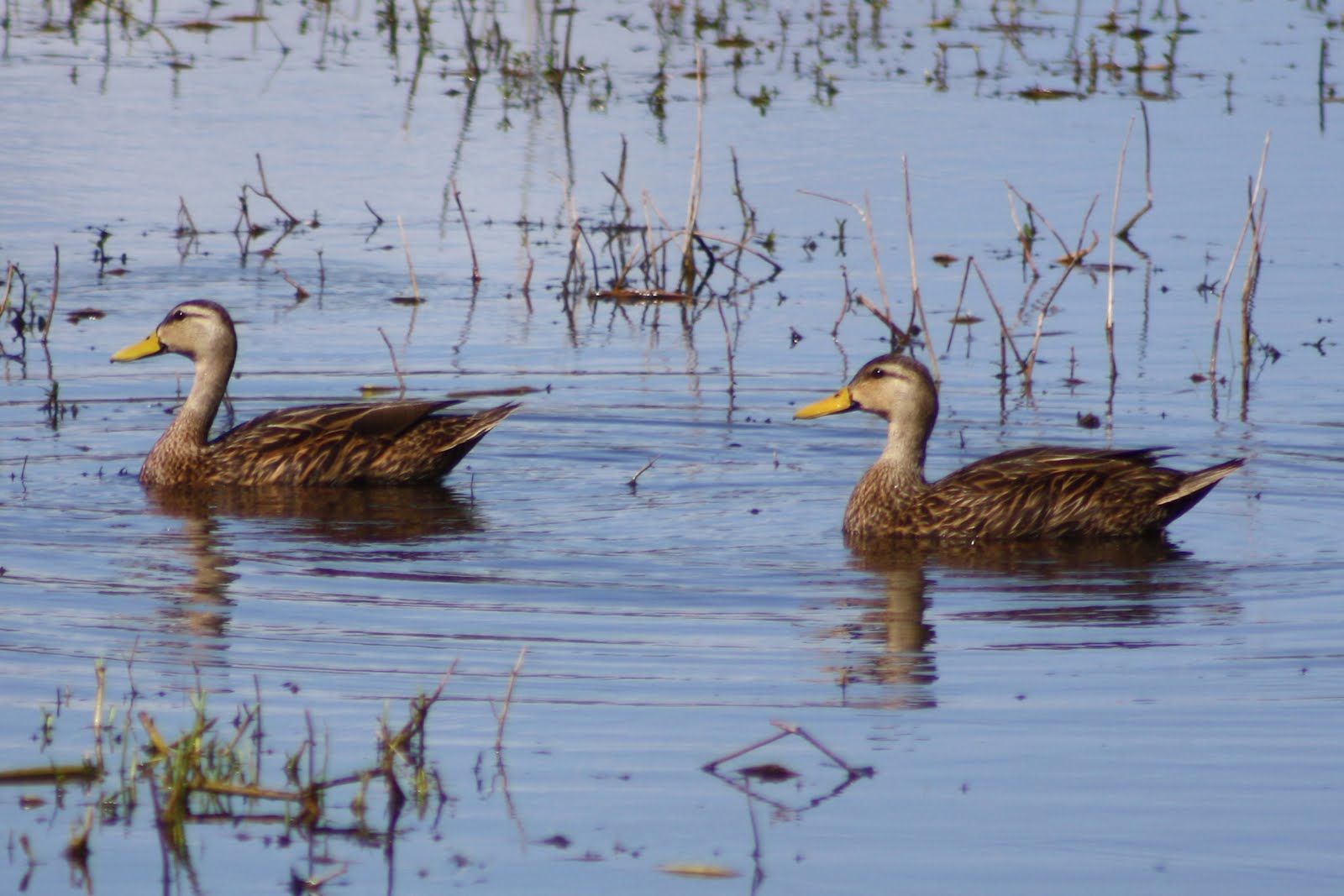

Their diet consists of grass seeds, stems, and roots along with other marsh plants. They also like bayberries and will consume crayfish, small fish, mollusks, and insects. They can be found in a variety of wetland habitats as well as upland habitats associated with wet areas like ponds, ditches, canals, etc.

While the population appears stable, loss of habitat due to development and agriculture has raised concerns, especially coupled with the hybridization problem (breeding with mallards). For more information about the hybridization problem and what you can do to help please go to: http://myfwc.org/wildlifehabitats/managed/waterfowl/hybridization/.

Tuesday, March 6, 2012

Critter of the Week March 5: American Robin (Turdus migratorius)


Sorry for the hiatus! Back in action again now with the American Robin (Turdus migratorius)! This thrush is a common and widespread bird and likely very familiar to everyone. This time of year they are passing through Florida up north since they are winter residents here. They tend to move in larger flocks, and I love to hear their high flight call!

For more info check out the website below!
http://www.allaboutbirds.org/guide/American_Robin/id/ac

Tuesday, February 28, 2012

Apologies!

Sorry for the hiatus! Back on track this afternoon/evening!

Wednesday, February 1, 2012

Plant of the Week: Earleaf Acacia (Acacia auriculiformis) INVASIVE EXOTIC

Earleaf acacia is native to Australia, Papua New Guinea, and Indonesia. It is an attractive tree, and this is what led to its introduction to Florida as an ornamental in the early 1930s. The leaves are slightly ear-shaped (as seen by the photo); well they make me think of floppy dog ears at least! And the leaves are actually flattened leaf stalks called phyllodes.


Phyllodes are an adaptation seen in plants that grow and thrive in hot climates and aid the plants in surviving through droughts. It is a fast-growing plant that does well in disturbed areas but has also invaded Florida scrub, pinelands, and hammock areas. This plant is an ecological threat because of its ability to out-compete our natives as well as shade out some of our rare plants.


For more information, please visit one of the following webpages.
http://plants.ifas.ufl.edu/misc/pdfs/SP257/Acacia_auriculiformis%28SP257-074%29.pdf
http://www.naturia.per.sg/buloh/plants/acacia.htm

Thursday, January 26, 2012

Plant of the Week: Simpson's zephyr lily (Zephyranthes simpsonii)


One of the best things about a prescribed fire in a mesic or hydric pine flatwoods is the appearance of zephyrlilies a few weeks post-burn. The lily seen here is, I believe, Simpson's zephyr lily (Zephyranthes simpsonii). It is listed as endangered in Florida and is endemic to peninsular Florida! We have these on Panther Island and other areas of Corkscrew. It seems to be that the limiting factor for its range is competition with other plants (another management reason for removal of invasive, non-native vegetation!). Mowing and other activities along roadsides, etc can reduce competing vegetation to levels were they are able to compete and survive. The main threats to its continued existence pertain to habitat changes such as over-drainage and development.

Monday, January 16, 2012

Critter of the Week January 16: American Bittern (Botaurus lentiginosus)


It seems like every time I post about a new critter I mention how much I love that species...well it is still true for the American bittern (Botaurus lentiginosus)! This lovely bird is actually in the heron family (Order: Pelicaniformes; Family: Ardeidae) and can be mistaken for another bittern, the least bittern (Ixobrychus exilis). These birds are found in marshes where they hide in the grasses and reeds. Their plumage is cryptic and allows them to blend in well with their surroundings. They forage on insects, crustaceans, fish, amphibians, reptiles, and small mammals. Solitary animals, they move slowly and somewhat stiffly. They snatch food with their bills and kill the prey with a rapid shake or bite. Because they can be hard to spy, it is often easier to identify them or recognize their presence through their distinctive call.
http://www.allaboutbirds.org/guide/American_Bittern/sounds/ac

American bitterns build their nests out of emergent vegetation (cattails, reeds, etc.) in shallow marshes about 3-8 inches above the water in dense thickets of emergent vegetation. The nests themselves are lined with grass and a typical clutch size is 1-5 eggs. Incubation lasts from 24-28 days.

Thursday, December 15, 2011

Holiday Hiatus!

Sorry guys but I am taking a holiday hiatus to work on my thesis and enjoy time with family! Here are some pics to enjoy while I am gone.